![[DEV] SC Policy Council](https://assets.nationbuilder.com/themes/64c02d01e8919c40538c4526/attachments/original/1677010541/logo-sc_policy.png?1677010541)


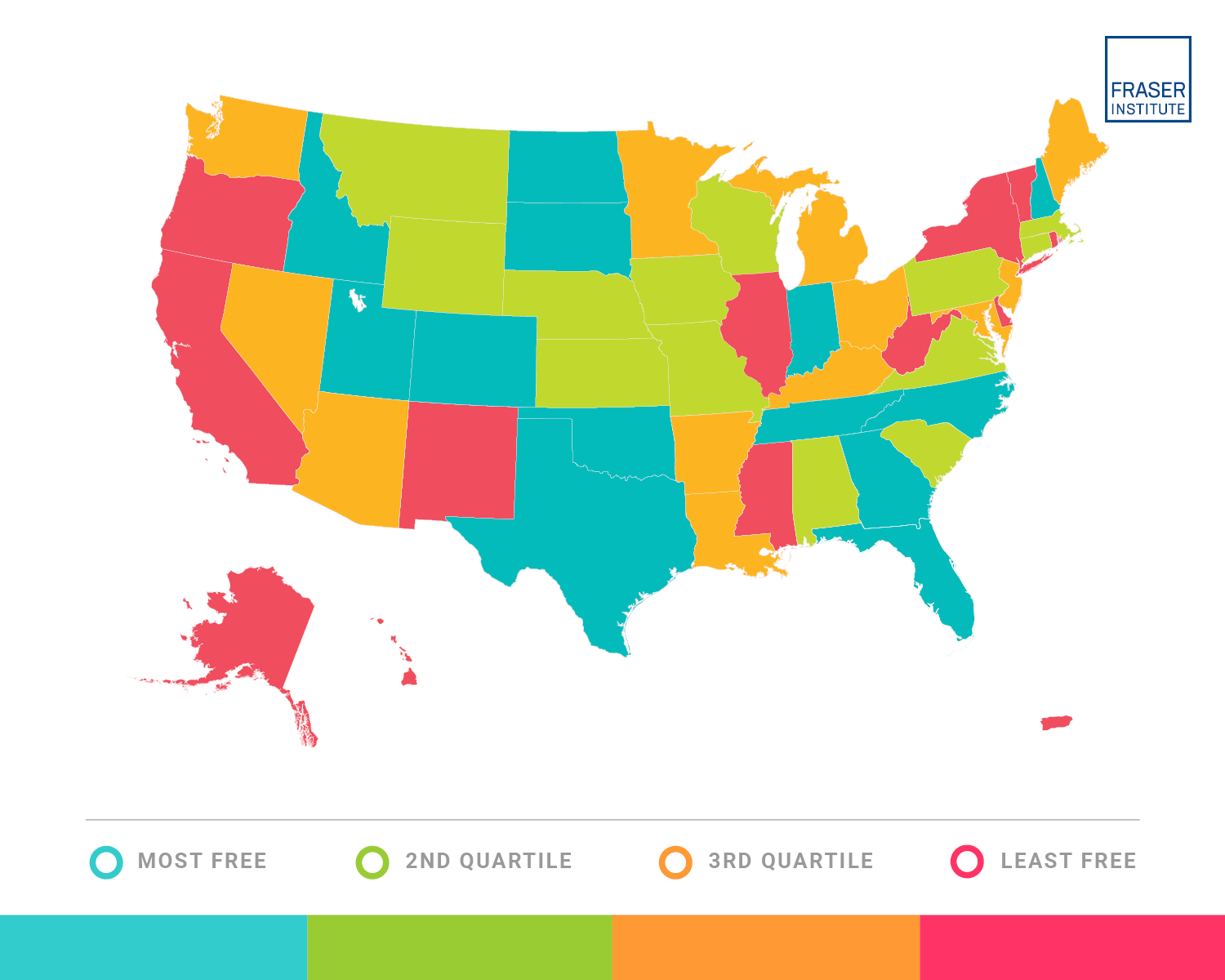
South Carolina ranks 21st nationally with an overall score of 6.84 in the Economic Freedom of North America (EFNA) report published by the Fraser Institute. People have more economic freedom when they are allowed to make more of their own economic choices. Based on 2023 data, the ranking places the state comfortably above average but well short of the top tier. That middle position is not puzzling. It reflects a state in which core economic institutions work reasonably well, but a single persistent constraint prevents further progress.
The solid, if not stellar, strength of South Carolina's economic institutions has enabled South Carolinians to prosper. The labor market clearly shows South Carolina’s strengths. SC ranks fifth in labor market regulation, 35th in spending, and 25th in taxing. According to the Bureau of Labor Statistics, the state has experienced solid job growth in recent years. Unemployment rates have generally tracked at or below the national average, indicating healthy labor demand rather than artificial tightness. Firms continue to expand in South Carolina because labor markets remain flexible and adjustment costs are manageable.
The output data helps reinforce that picture. Bureau of Economic Analysis (BEA) state GDP figures show South Carolina's real GDP growing at a competitive pace, with strong gains in export-oriented manufacturing and transportation-related sectors. These outcomes are consistent with economic theory. When labor markets are flexible and regulatory barriers are moderate, investment responds.
Yet EFNA can explain why this growth has not translated into a higher ranking. The constraint is not state-level labor or tax policy. It is local government spending and taxation.
EFNA measures combined state and local burdens, and this distinction matters. While state-level fiscal policy in South Carolina has been comparatively restrained, local government spending has grown faster than population growth in many counties. Property taxes have followed. From an economic perspective, the total burden matters, not which level of government imposes it.
Local taxes are particularly distortionary. Property taxes can raise the cost of housing and commercial investment, reduce capital formation, and disproportionately affect small businesses that lack geographic mobility. EFNA captures this effect by measuring taxes relative to personal income rather than focusing exclusively on statutory rates or isolated policy changes.
The data shows the consequences. BEA figures reveal growing divergence in per-capita GDP growth across regions of South Carolina. Areas with faster local spending growth and higher effective property-tax burdens exhibit slower output growth than lower-tax peers. This is not a coincidence. Capital responds to relative returns, and local fiscal policy directly shapes those returns.
Directionally, South Carolina’s EFNA ranking has been remarkably stable over time. Stability, in this case, is not a feature. It indicates that while the state has avoided major policy mistakes, it has also failed to remove the constraints preventing upward movement. Other states with similar labor-market advantages moved ahead by pairing flexibility with tighter local fiscal discipline.
The timing of the data is important. Because the EFNA report relies on 2023 data, recent local reform discussions or proposals are not yet reflected in it. What the ranking captures is the cumulative effect of local fiscal decisions made over the past decade. EFNA moves slowly because institutions change slowly. That is precisely why it is useful for evaluating structural competitiveness rather than political momentum.
The Fraser Institute’s research shows a consistent relationship between economic freedom and prosperity. States with higher economic freedom experience stronger job creation, higher incomes, greater in-migration, and more resilient growth. South Carolina already benefits from several of these dynamics, but the gains are uneven and increasingly localized.
The economic lesson is straightforward. South Carolina does not need a new growth strategy. It needs spending restraint. State-level policies that support labor flexibility and investment are being undermined by state and local spending excesses that raise costs and reduce returns. Until those incentives are aligned, growth will continue, but it won't be as brisk as it would be if the state permitted its citizens more economic freedom.
Economic freedom compounds when constraints are removed systematically. South Carolina has addressed some of those constraints. The next gains will come not from doing more, but from allowing governments to do less.
This report may be republished in whole or in part, provided that proper credit is given to the author(s) and the South Carolina Policy Council.