![[DEV] SC Policy Council](https://assets.nationbuilder.com/themes/64c02d01e8919c40538c4526/attachments/original/1677010541/logo-sc_policy.png?1677010541)



Update 4/29/26: S.831, a bill previously resembling H.5071, has passed the House in which many of SCPC's recommendations were adopted. Click here for the updated bill report.
Executive Summary
South Carolina has consistently increased spending on road repairs and new construction over the past several decades. Yet despite the 2017 state gasoline tax hike, which lawmakers promised would be used to fix the state’s deteriorating roads and bridges, the Palmetto State has seen a negative return on that investment in terms of overall quality. Declining road quality, stagnant safety improvements, and an ever-expanding budget show that the central challenge is not a lack of funding but rather structural inefficiencies within the governance and management of the S.C. Department of Transportation (SCDOT).
Authority is currently fragmented among numerous entities, including the SCDOT Commission, legislative delegations, the S.C. Transportation Infrastructure Bank (STIB), and County Transportation Committees (CTCs). This structure diffuses accountability and makes it difficult for taxpayers to determine who is responsible for results. Meaningful reform requires:
- Consolidating authority by allowing the governor to nominate the Department of Transportation Secretary with Senate confirmation.
- Abolishing the SCDOT Commission and the STIB.
- Simplifying project prioritization.
- Reevaluating road ownership to determine which roads should remain under state responsibility.
Introduction: The Need for Structural Reform
South Carolina offers diverse geography, from the Blue Ridge Mountains along the state’s northern border to the Atlantic coastal regions, yet the infrastructure connecting these areas is in dire condition. State lawmakers are currently searching for solutions to create an agency that can effectively execute repairs and new construction.
Public sentiment supports this urgency; a recent South Carolina Policy Council poll found that 58% of voters are against funding increases for SCDOT until structural reforms ensure tax dollars are effectively spent. To reach its potential, SCDOT must be restructured to move beyond its current standard of performance.
Dissecting the Funding Myth
A primary hurdle to reform is the misconception that a lack of funding is the essential issue. For the new fiscal year that starts July 1, Governor McMaster recommended a $1.1 billion increase to combat inflation-related delays. However, SCDOT’s annual budget has ballooned over 120% between 2013 and 2025 ($1.4 billion to $3.1 billion), far outpacing the cumulative inflation rate of 32.8% as calculated by the Consumer Price Indexes (CPI).
Infrastructure and Safety Trends (2013–2024):
- Declining Quality: While the national average of "acceptable" road conditions increased from 79.18% to 80.95% from 2013 to 2024, South Carolina’s acceptable rate dropped from 86.82% to 80.26% during the same period, according to the U.S. Bureau of Transportation Statistics.
- Safety Concerns: The 2023 Mileage Death Rate (MDR) in South Carolina was 1.72 per 100 million miles traveled by vehicles – the third-highest rate in the nation and significantly above the national average of 1.26, according to the Federal Highway Administration.
- Economic Impact: Pothole-damage claims filed with SCDOT rose from roughly $5 million (2018–2020) to $43.5 million (2020–mid-2025), The Nerve revealed last year. During this latter period, less than $5 million in settlements was approved.
SCDOT is currently responsible for over 41,000 miles of the state's 60,000 public road miles. This level of centralized control is matched by only a few states, such as Texas, North Carolina, and Virginia.
The Governance Web: A Crisis of Accountability
A poll conducted last year by the Policy Council found that 61% of voters believe SCDOT does not manage road maintenance and repairs effectively. When looking at the convoluted leadership structure of the department, it becomes clear why citizens hold this position.
The current leadership structure is a convoluted web that prevents taxpayers from identifying responsible parties. The appointment process for the Secretary contains multiple layers where different actors can affect control over the process.
- The SCDOT Commission: This nine-member body approves the budget and decides which statewide roads get priority. Seven members are confirmed by state legislative delegations representing the seven U.S. Congressional districts rather than the full General Assembly, which diffuses accountability.
- The Transportation Secretary: Appointed by the Commission, the Secretary handles daily operations but is ultimately subject to the Commission's authority.
- South Carolina Transportation Infrastructure Bank (STIB): An independent agency with its own seven-member board, the STIB provides grants or loans for large projects of at least $25 million by law and often more than $100 million, typically financed with state revenue bonds. Regional projects often are prioritized over statewide needs.
- County Transportation Committees (CTCs): These committees, which vary in size and are appointed by state legislative delegations representing their respective counties, approve local projects using a portion of the state gasoline tax, known as “C-funds.” CTCs are required to spend a portion of their C-funds on the state highway system. There is no explicit legal requirement for CTC members to live in the county they serve.
The following flow chart illustrates the current complexity of appointing and determining what entity is responsible for each task: 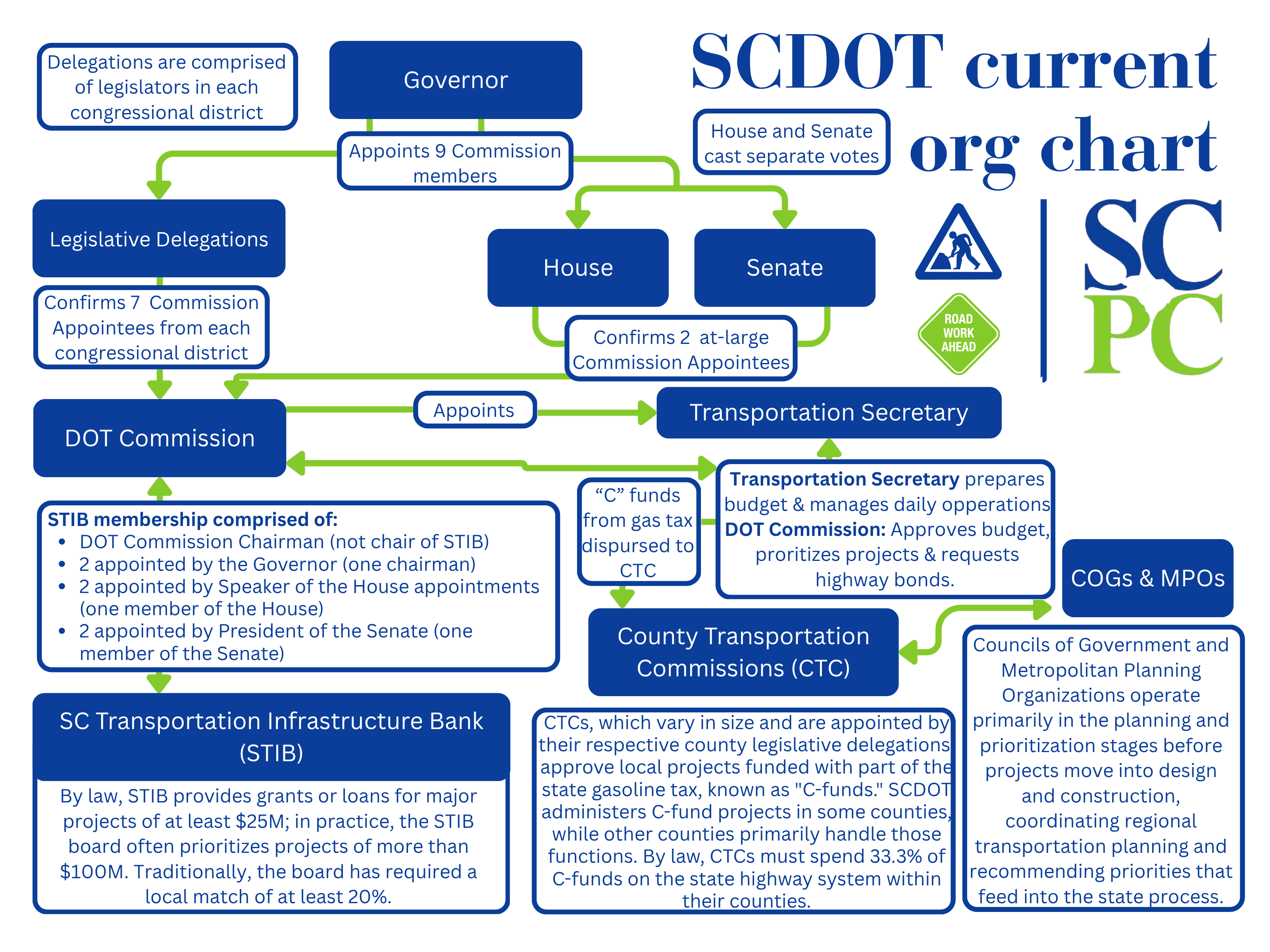
When failures occur, the diffuse nature of this structure allows various parties to deflect responsibility to other parts of the process.
Previous Reform Efforts: The 2016 Legislative Audit Council Report
The General Assembly is well aware of these issues, as evidenced by a 2016 performance audit of SCDOT by the Legislative Audit Council (LAC), which is the Legislature’s investigative arm. Key findings included:
- Prioritization Inefficiency: The LAC found no fewer than 157 separate project prioritization lists across 15 categories. They recommended a single, streamlined "worst-first" list to improve cost-efficiency.
- Inflation and Indexing: The LAC recommended indexing the state gas tax to an economic indicator like the CPI. Instead, lawmakers subsequently implemented a flat 2-cent annual increase for six years through 2022 without adjusting for inflation.
- Structural Redundancy: The LAC recommended either eliminating the STIB or making it a subsidiary of SCDOT.
Lawmakers, however, largely ignored the LAC’s findings.
Our Take: Restructuring for Results
While both House and Senate proposals are under consideration, we offer the following proposals:
1. Consolidate Executive Authority
The governor should nominate the SCDOT Secretary, subject to Senate confirmation like any other cabinet-style agency. Simultaneously, the legislative delegations’ confirmation powers and the SCDOT Commission should be abolished. This would create a clear chain of responsibility and enable decisive leadership by eliminating redundancy and unnecessary additional actors.
Additionally, reducing the number of parties involved in project prioritization would allow decisions to reflect the transportation needs of the state without additional confounding variables. Streamlining the agency structure as noted above would effectively solve this issue.
2. Abolish the STIB
The STIB operates with limited oversight and struggles to allocate resources efficiently, often favoring political influence over technical need. Its financing functions should be merged directly into SCDOT, which already possesses the technical expertise to manage STIB-approved projects.
3. Utilize Public-Private Partnerships (P3s) and Choice Lanes
P3s allow private companies to share the risks and upfront costs of infrastructure. Florida’s use of a P3 for I-595, for example, reduced the project timeline from a projected 20 years to just over four years, records there show.
In South Carolina, a study on improving I-526 in Charleston estimated that using a P3 for "choice lanes" with tolls could reduce estimated state costs from $7 billion to $4.6 billion while significantly improving commute times.
To avoid the common criticism that tolls effectively amount to "double taxation," S.C. lawmakers should provide fuel tax rebates for motorists who use toll-funded roads or choice lanes.
4. Return Road Control to Localities
SCDOT maintains roughly two-thirds of the state's roads, leaving it stretched too thin. South Carolina should transition secondary roads under SCDOT’s jurisdiction to county and municipal control while at the same time ensuring that the state funds for those roads flow to the local levels. This shift should be guided by a statewide plan that allows SCDOT to focus on interstates and state highways, with local communities setting their own road priorities.
The reality is that South Carolina is approaching a structural breaking point, with SCDOT stretched too thin and often prioritizing major corridors while smaller; local roads fall by the wayside. Grounded in the principle of local autonomy, this approach would better align road oversight with community needs, and while concerns about property taxes are valid, a leaner SCDOT could return excess funds to help offset the shift.
Current Legislative Analysis: H.5071
The General Assembly is currently considering a House bill (H.5071) aimed at overhauling South Carolina’s road-management system.
Positives of H.5071:
- Leadership Restructuring: Designates the Transportation Secretary as the sole governing authority for many functions. Also transfers responsibilities previously held by the Commission to four deputy secretaries accountable to the Secretary.
- Public-Private Partnerships: Introduces P3s and choice lanes to speed up construction times, reducing inflationary costs.
- Alternative Fuel Fee: Addresses revenue gaps by updating fees for electric and hybrid vehicles and indexing the fees to the CPI. The fee increases mirror the average gas tax owners of gas vehicles pay annually.
- CTC Accountability: Countywide transportation plans must include project selection criteria (road condition, safety, traffic efficiency, economic development) and must be updated at least every four years. CTC members must also live in the county they serve.
- Pothole Mitigation Program: Allocates $15 million of existing department funds to permanently fill potholes along the state highway system. Citizens will be able to report potholes online or via an app on their phones.
-
Local Road Control: Creates a 12-member Coordinating Council for Transportation and Mobility to identify state-owned roads for counties and municipalities to request control of. CTCs in counties that assume control of local roads will be exempt from spending C-funds on the state highway system.
Shortcomings of H.5071:
- Retention of the Commission: Retains the SCDOT Commission for "local representation," which continues to diffuse accountability.
- STIB Status Quo: Fails to address the underlying issues with the STIB or implement the LAC recommendation to eliminate it.
- Double Taxation: No gas tax rebates for toll road/choice lane users.
- Local Tax Hikes: Counties and municipalities that take control of state roads can increase local property and sales taxes to cover increased costs without a referendum.
Overall, although H.5071 takes certain positive steps, it fails to execute the total structural reform necessary to end the cycle of inefficiency at SCDOT.
Conclusions
South Carolina's infrastructure challenges are a byproduct of structural flaws, not just a lack of funding. To ensure long-term success, the state must:
-
Simplify Accountability: Move to a cabinet-style agency under the governor. Transportation Secretary nominated by the governor and confirmed by the Senate.
-
Streamline Prioritization: Reduce the number of parties involved in setting project agendas to focus on infrastructure needs rather than political variables. Specifically, by abolishing the STIB and the DOT Commission.
-
Modernize Financing and Construction: Rely on P3s and tolling for new capacity to reduce state risk and project timelines. Allow for the construction of choice lanes and toll roads to ease public traffic flow.
- Balance Control: Return secondary road responsibility to counties and local municipalities, allowing the state to focus resources on the primary highway system.
The South Carolina Policy Council (SCPC), founded in 1986 by Thomas Roe, is the state's longest-serving free market research organization. It is an independent, nonpartisan group dedicated to promoting limited government, individual liberties, free markets, and traditional South Carolina values.
This report may be republished in whole or in part, provided that proper credit is given to the author(s) and the South Carolina Policy Council.